
Parole vs Probation in Merced
California parole and Merced County probation are not the same record system. CDCR's Division of Adult Parole Operations supervises people released from state prison to parole. Merced County Probation supervises local court orders, including adult probation, pretrial services, mandatory supervision, PRCS, collaborative court supervision, and other county programs. A released jail detainee may be under local supervision without ever entering CDCR. A person sentenced from Merced County to state prison moves into the CDCR release path, and later parole questions belong to DAPO rather than the Sheriff's jail records desk.
| Supervision type | Who handles it | Release meaning |
|---|---|---|
| Pretrial release | Merced County Probation Pretrial Services and the court | The person is out of jail while the case is still pending and may have reporting or program conditions. |
| Adult probation | Merced County Adult Supervision | The sentence or court order is supervised locally after release from jail or instead of a longer custody term. |
| Mandatory supervision or PRCS | Merced County Probation | The person is out of jail or prison but still supervised through county realignment programs. |
| CDCR parole | CDCR Division of Adult Parole Operations | The person was released from state prison and is supervised by the state parole system. |
How to Verify Merced Supervision
Start with the custody path, then move to the supervision office that matches it. The Merced inmate inquiry can show a booking history, `Release Date`, `Scheduled Release Date`, prisoner type, court date, charges, and bond or bail details while a booking is visible. It also includes `SUPERVISED RELEASE` as a housing-facility option, which is a local warning that physical release from jail may still be tied to a court or probation status. If the person has disappeared from the visible roster, use the court case, VINE, and records request path before assuming that supervision ended.
- Search the Merced County Sheriff inmate inquiry by name, subject number, or booking number, then open the detail page if a match appears.
- Look for `Release Date`, `Scheduled Release Date`, prisoner type, court, sentence, disposition, bond, bail, and any status suggesting supervised release or transfer.
- Use California VINE to check for a custody-status change if the person was recently released or transferred.
- For local supervision, contact Merced County Adult Supervision or Pretrial Services, depending on whether the case is post-sentence or pending.
- For state-prison release, use CDCR CIRIS, BPH parole resources, and the DAPO Northern Region parole unit serving Merced.
- If the online record no longer shows the booking, request the release record from the Sheriff's Records Bureau with identifying details and required ID.
Merced County Supervising Offices
Merced County Adult Supervision is the local contact point for people released under county probation, mandatory supervision, PRCS, or related adult supervision orders. The Probation Department directory also lists the main department at Wardrobe Avenue, while Adult Supervision is listed separately on Olive Avenue. For a state parolee returning to Merced County after CDCR custody, the CDCR Northern Region directory lists a Ceres/Merced parole unit at West 15th Street in Merced. That division matters because a county probation officer cannot verify a state parole term, and a parole unit is not the public jail roster.
Merced County Adult Supervision
600 W. Olive Avenue
Merced, CA 95340
(209) 381-1380
Fax: (209) 725-3737
Merced County Probation Department
1880 Wardrobe Avenue
Merced, CA 95340/95341
(209) 385-7494
Monday-Friday, 8:00 a.m.-5:00 p.m.
CDCR DAPO Ceres/Merced Unit
439 West 15th Street
Merced, CA 95340
(209) 726-6513
State parole contact for CDCR releases serving Merced County.
Use the Sheriff's Records Bureau when the question is the jail release record itself. The Bureau is listed at 777 W. 22nd Street, Merced, CA 95340, with mail directed to 700 W. 22nd Street, Merced, CA 95340. The Records Bureau phone is (209) 385-7614, fax is (209) 724-4016, and listed office hours are Monday through Friday from 8:00 a.m. to 5:00 p.m., excluding holidays.
Local Reentry and Pretrial Supervision
Merced has a local supervision landscape that is broader than a jail release date. Pretrial Services conducts assessments and provides program services and supervision for defendants while on pretrial release according to risk level. County sources also connect release to the Community Corrections Partnership, Breaking Barriers, the Day Reporting Center, and jail release and transition planning. That means release from the Main Jail or JLCC may be followed by reporting, program attendance, case activity, or community-based supervision rather than a closed criminal-history event.
The Sheriff's jail information material says program participants may develop a Release Plan 30 to 60 days before expected release and a Transition Plan for community needs. Those plans are not a public release list, and they do not prove that a person has been discharged. They do show why the local records workflow should treat release as a sequence: expected date, court or jail action, custody-status update, and any supervision or program follow-up.
Records Bureau ID Requirements
When online custody tools stop showing a person, the official release-confirmation path may become a records request. Merced County Sheriff's Records Bureau instructs requesters to provide identifying information and a copy of a driver's license or California ID. The research notes that applications without ID are returned rather than processed. That requirement is important for a released person whose jail detail page has dropped from public display, or for a family member trying to confirm the time and manner of release under California public-records law.
The request form asks for details such as date and time reported, reporting person, victim, location, suspect, requestor, claim or court number, type of record, and reason for request. For supervision questions, the most useful identifiers are usually name, date of birth if known, booking number, subject number, court case number, arrest date, and the facility involved. The records response may explain a release date or transfer, while the court or probation office explains the supervision order that followed.
CDCR Parole Hearings and Results
A Merced County conviction can lead to state prison, where release questions shift to CDCR and the Board of Parole Hearings. BPH publishes hearing schedules and parole-suitability hearing results. The research found that schedules are updated weekly on Thursday morning and include hearing date, time, location, and whether the hearing is in person or by video conference. Results use terms such as grant, deny, continue, cancelled, split, postpone, waive, and stip. A grant means a recommendation for parole that is still subject to review; it is not the same thing as a person already walking out of custody.
For indeterminate cases, Penal Code section 3041 and BPH parole-eligibility materials explain parole consideration timing. BPH also defines EPRD, MEPD, NPED, YPED, and EPED for different release or eligibility contexts. A parole hearing belongs to the state-prison track, not the county 24-hour release workflow. For a county jail release with local supervision, use Probation and court records first. For a state-prison release back to Merced County, use CDCR CIRIS, BPH records, and DAPO.
DAPO Wanted Status Caution
CDCR DAPO publishes a wanted-offenders channel for sex offenders being sought by Adult Parole Operations. The research does not identify that as a general list for every Merced County probationer or parolee. Treat it narrowly. If a person appears in a DAPO wanted context, the correct phrasing is that the person may have been released to supervision and later became wanted or absconded. That is different from being in current jail custody, different from a completed discharge, and different from an ordinary released status with no active supervision problem.
For county probation violations, use the court file and local probation contacts. A violation can result in a warrant, a court hearing, a remand to custody, a supervision modification, or another order. VINE may help with custody-change alerts if the person is booked again, but VINE is not a complete probation history and does not replace the court record.
County Probation vs State Parole Contacts
Merced's local detail makes the agency split unusually clear. Adult Supervision is at 600 W. Olive Avenue for local probation and post-release county supervision. CDCR's Northern Region directory lists the Ceres/Merced parole unit at 439 West 15th Street for state parole. The Sheriff's Main Jail at 700 W. 22nd Street and the jail information line at (209) 385-7410 remain useful for custody status and jail records, but they do not supervise someone after a state-prison release.
Before calling an office, identify the last custody system. If the person was booked at the Main Jail, JLCC, or Los Banos Police Holding and released locally, start with the Merced inmate inquiry, court record, VINE, Records Bureau, and Adult Probation. If the person was sentenced to CDCR, start with CIRIS and DAPO. If the person was federal, use BOP rather than county or CDCR tools. Those distinctions prevent a common Merced mistake: treating every person who left jail as a parolee, or every parolee as a county probationer.
Adult Probation Source View
The Merced Adult Probation page is the local source for Adult Supervision contact routing. Use it as a lead-in to probation verification, then confirm the person-specific order through the court, probation contact, or release record rather than through a generic roster.
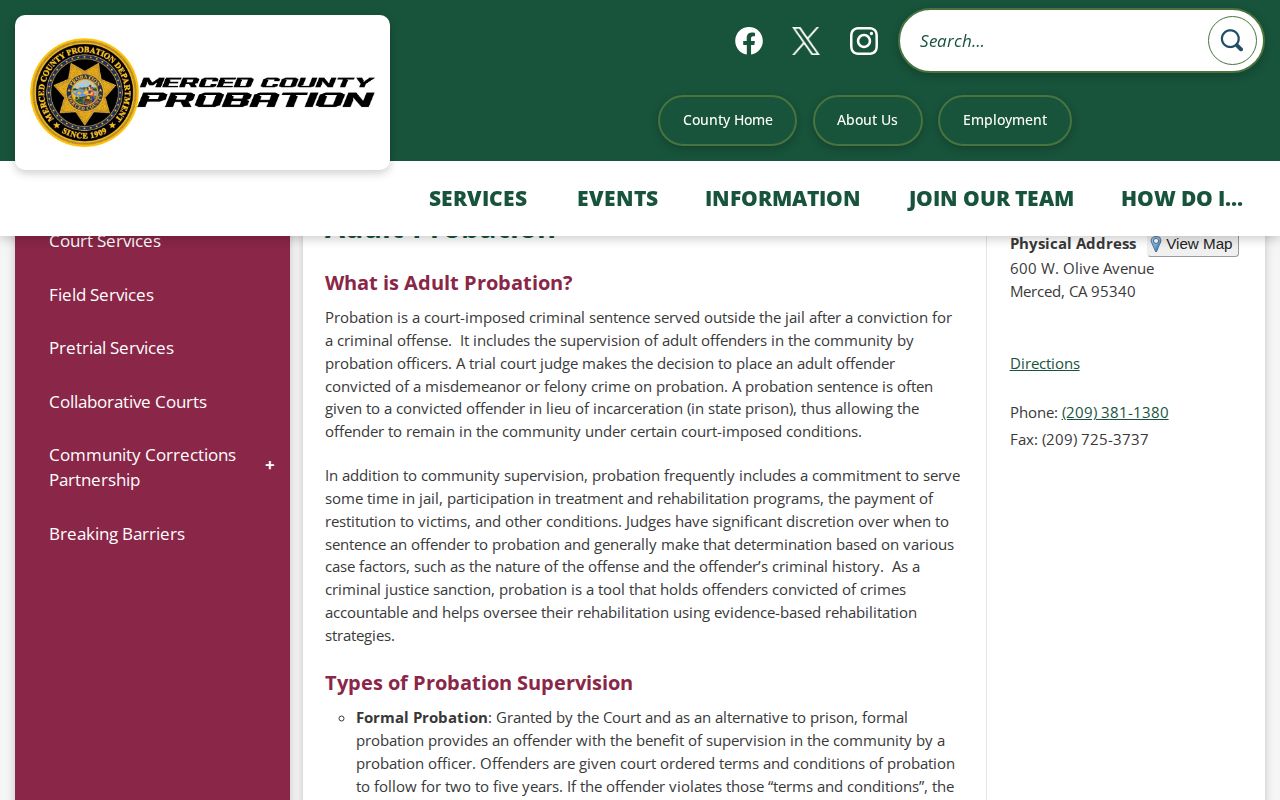
After reviewing the office page, match the person to the supervision type before contacting the office: pretrial release, adult probation, mandatory supervision, PRCS, or CDCR parole.
How Merced Supervision Ends
Supervision can end by court order, sentence completion, probation discharge, parole discharge, revocation, transfer, dismissal, or a later post-disposition record update. The jail release date alone does not answer that final-status question. California Government Code section 7923.610 supports public access to specified arrest information, including time and manner of release, but supervision status usually requires the court, Probation, DAPO, or CDCR record that controls the person after custody.
Merced Public Defender materials also identify a local post-disposition dismissal and reduction path, while California Courts warns that clean-record law is technical. Those record updates are separate from physical release. If a person needs the custody timeline, start with the release record. If the question is whether a case, conviction, probation term, or parole term changed later, follow the court or supervising-agency record instead.